
A Pakistan-side record, reviewed for UK use
Online Nikah Legal Service coordinates marriage enquiries connected to the United Kingdom from our Karachi consultation offices. The first conversation can begin remotely; the applicable Pakistani requirements, Union Council jurisdiction and any UK-side recognition questions are confirmed after the case is reviewed.
A Pakistani Nikah and its registration create a Pakistan-side record. Whether that record is recognised for immigration, civil or family purposes in the UK is a separate question decided by the receiving UK authority or a UK-qualified adviser. We do not promise an instant ceremony, a guaranteed visa or UK recognition.
What “Online Nikah for the UK” means in practice
“Online Nikah” is a shorthand for starting the consultation, document review and coordination remotely — not a separate legal category of marriage. The Nikah itself is the same Islamic and statutory event whether planning begins over a video call from London, Birmingham or Manchester or in person in Pakistan. What changes is convenience, not the requirements.
A responsible service treats the remote conversation as the first step. It does not remove identity checks, free consent, the presence of witnesses, the role of a wali where applicable, or registration with the Union Council. See our step-by-step procedure for how these stages fit together.
Eligibility, consent and legal capacity
Both prospective spouses must freely and knowingly consent. Free consent is the foundation of a valid Nikah, not a formality. Legal capacity — including the applicable minimum age and the absence of a bar from a prior undissolved marriage — must be confirmed for the relevant jurisdiction. We do not coordinate underage, coerced or misrepresented marriages.
Where one or both spouses hold British nationality or indefinite leave to remain, UK immigration rules may impose additional conditions on how a marriage is conducted and recognised. A prior marriage, divorce or bereavement may raise further requirements. Disclose the facts accurately at the first consultation so the correct evidence can be assessed before any arrangement is confirmed.
Identity documents to prepare
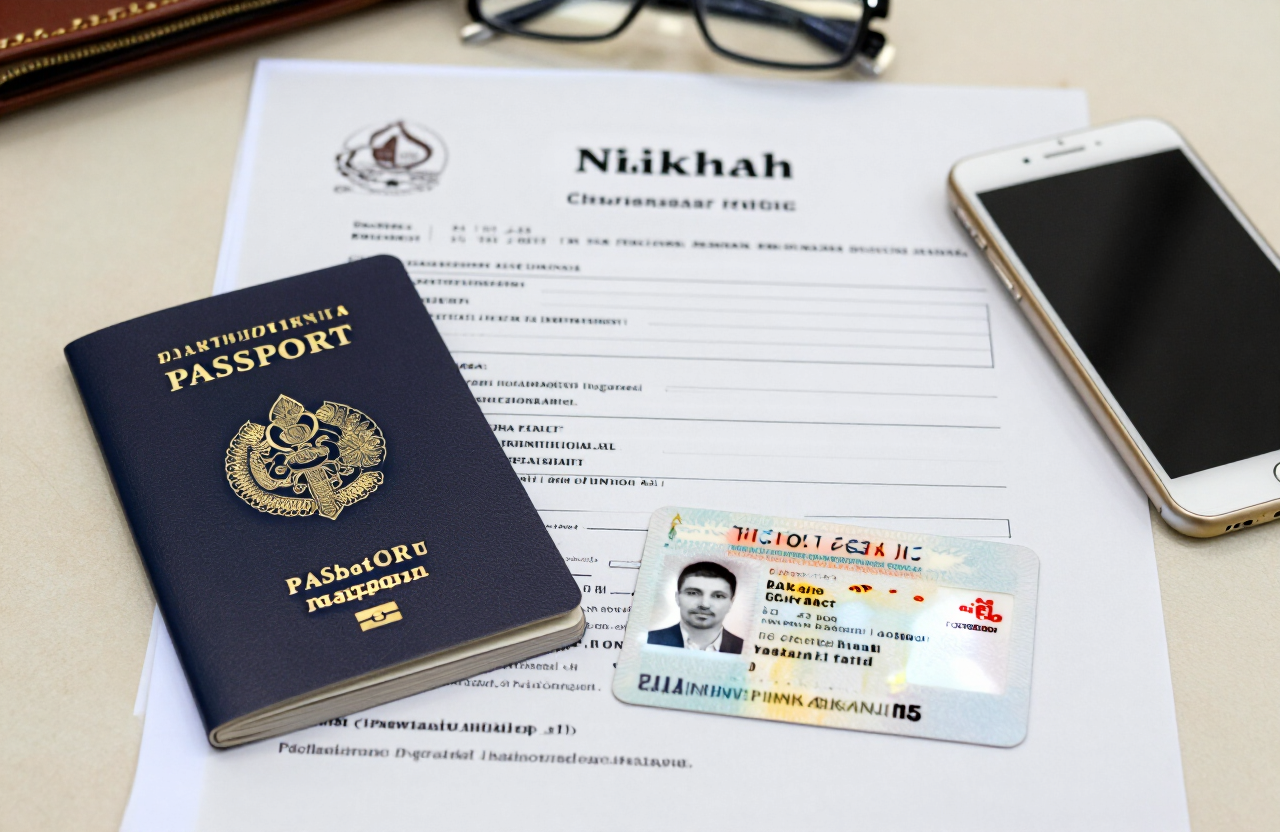
Begin with a short summary of your situation rather than full identity documents. After the initial review, send only the records needed for the agreed task. The exact list depends on your circumstances, but the following are commonly relevant for a UK-connected marriage.
- CNIC or NICOP for each Pakistani-national spouse and witness
- British passport or UK residence document where applicable
- Final divorce decree (Decree Absolute) or death certificate where there was a prior marriage
- Two witnesses with valid identity records
- Any authorisation or power of attorney where a representative is proposed
Representation and power of attorney
Where one spouse cannot travel to Pakistan, Islamic law and Pakistani practice may allow a representative (wakil) to act on the basis of a valid authorisation. For UK use, a power of attorney executed in the UK may need notarisation and FCDO legalisation before it can be considered in Pakistan. The authorisation, identity and participation route must be assessed for the specific case before any ceremony is arranged.
A video call alone is not, by itself, a legally sufficient ceremony. Do not assume that an arrangement permitted or recorded in Pakistan is recognised for every UK purpose. UK immigration and civil-registration authorities can treat remote or proxy marriages differently, and some applications impose additional restrictions. Seek current advice from a UK-qualified adviser before committing to a route.
Witnesses and the Nikah procedure
In Islam, marriage is a contract formed by a clear offer (ijab) and acceptance (qabul) between two eligible people, in the presence of witnesses. The contract ordinarily includes an agreed mehr and may include other agreed terms. A Nikah registrar licensed by the Union Council ordinarily performs and records the marriage.
Witnesses are central to the Islamic contract, and the role of a wali applies where the relevant school of thought or local rule requires it. Their identity and presence must be genuine and verifiable. Where witnesses are in the UK and the ceremony is in Pakistan, their physical presence or a validly authorised substitute must be arranged in advance.
Pakistani registration, translation and attestation
Registration of the marriage with the Union Council under the Muslim Family Laws Ordinance, 1961 is a statutory step, and the Nikah Nama is the form through which it is recorded. A NADRA computerized marriage certificate is typically issued on the basis of that record. Skipping registration does not erase the legal duty to register.
For UK use, the receiving authority may ask for a certified English translation and FCDO legalisation (apostille) of the Pakistani documents. Translation must reflect the actual entries and is not an opportunity to revise the contract. Attestation authenticates a document; it does not guarantee UK recognition of the underlying marriage or a visa outcome.
UK recognition and immigration considerations
The UK decides separately whether it recognises a Pakistani marriage for immigration, civil or family-law purposes. A religiously solemnised and registered Pakistani marriage is not automatically treated as a valid UK marriage for every purpose. The Home Office, HM Passport Office and UK courts each apply their own tests.
UK spouse and family visa applications can impose additional restrictions on remote or proxy marriages, even where a Pakistan-side record exists. Confirm the current requirements with the Home Office or a UK-qualified immigration adviser before paying for a route intended for UK use. No Pakistan-side coordination service can guarantee a UK decision.
How to inquire and what happens next
Start with a confidential consultation using the form below, or message us on WhatsApp at +92 331 6644789. Share where both prospective spouses live, their nationality, marital history and the intended UK use of the documents. We review the case before confirming what can be coordinated.
Our usual Nikah coordination and registration-assistance fee is PKR 40,000–60,000 depending on the agreed scope, with 50% in advance and 50% after completion of the agreed services. Authority charges, translation, attestation, courier and travel are disclosed separately. See fees and procedure for the full breakdown.